In a previous post, I presented a logical, factual argument for the existence of God. But one of my readers, Seanny McShawn, took issue with my syllogisms, saying that I was simply making an argument “from incredulity”.
When someone tries to win an argument based on simple probabilities, this is called an “argument from incredulity.” This is a logical fallacy. In other words, the sheer unlikeliness of a scenario does not preclude its possibility and cannot be proof against it.
But was I arguing from “incredulity”?
Physicists estimate that in our universe there are 10
80 particles. Mathematicians say that the
mathematical level of absolute impossibility is 1 chance in 10
50. However, the
physical level of absolute impossibility is 1 chance in 10
80, and here’s why:
On the basic level, probability is defined by the ‘particle’ example: finding a specially marked particle among 500,000 particles is beating odds of 1 in 500,000. In a universe that has 10
80 individual particles, the
most improbable scenario is finding a specially marked particle in the entire universe.
Due to the size of our universe, it is
impossible to have a
more improbable set of odds than 1 chance in 10
80. Anything that is
more improbable than the
most improbable is by all standards
absolutely impossible.
Mr. McShawn also took issue with the famous atheist Sir Fred Hoyle’s calculations that the probability of producing life by chance is 1 in 10
40,000. So, last night I ran a set of calculations that should clear up the problem. I found that Sir Hoyle’s calculations were, in fact, incorrect.
Life is composed of proteins. Proteins are highly organized arrangements of amino acids. The Miller-Urey experiments showed that under certain finely tuned circumstances, amino acids can be produced. These amino acids were in the wrong balance to support life, but the experiment did show that intricate design is not absolutely necessary to create them.
So let us assume, for the sake of argument, that in the primordial ooze billions of years ago enough amino acids were produced in the right concentration to provide the building blocks of life. Let us further posit that, through some volcanic or hydrologic freezing cycle, natural bond energies arranged themselves in such a way as to intricately fold millions of amino acids into the perfect proteins necessary for the next prebiotic step.
Let us further assume that these proteins, through lowest energy bond formations, aligned themselves in such a way as to form a double helix of deoxyribonucleic acid, or DNA. At the same time, an equal amount of RNA was produced to help copy the DNA in the absence of ribosomes.
Nature magazine has done several extensive studies to investigate the absolutely simplest reproducing life form. According to
this article, the simplest bacteria would require only a few basic functions: the ability to ingest raw materials, convert them into amino acids, synthesize the acids into proteins, and arrange the proteins to make a cell wall, more DNA, and more protein building cell mechanisms.
To have these functions,
Nature estimates that at minimum 200 genes would be required. According to
Wikipedia, the average bacterial gene has around 1000 base pairs, for a total of 200,000 “bits” of information necessary to sustain life.
Each “bit” has four possibilities: A, T, G, and C. These are the four proteins which comprise the “rungs” on the ladder of the DNA double helix. With 4 possible values for each of the 200,000 base pairs, the odds of getting the first base pair correct is 1 in 4. The odds of getting the first two base pairs correct is 1 in 4 x 4, or 1 in 16. The odds of getting 200,000 base pairs in the correct order are as follows:
1 chance in 1.0 x 10120,412
Remember that it is physically impossible, in this universe, for random chance processes to defeat any odd greater than 1 in 10
80. Such being the case, the verdict for DNA arranging itself in a manner favorable to life is 10
1505 times the level of absolute physical impossibility.
And the odds are not that much better if we reduce the gene requirement to only one gene. The chance of randomly selecting a single gene correctly is 1 in 6.5 x 10
1113.
Even if all the genes had already been written somehow, the chance of getting them in the correct order (the only order in which reproduction is possible) is 1 in 1.6 x 10
460.
This is not an argument from incredulity. This is an argument from facts: cold, hard facts. Since any set of odds above 1 in 10
80 is absolutely impossible, random chance could not and did not produce life.
Speaking of which, try listening to this song by Mike Reese. I am sure you will enjoy it. If you cannot play the clip from this page, you can try clicking
here.
Any questions?
In Him,
David S. MacMillan III
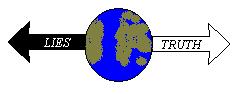 But it is really not this way. Everyone has their own concept of truth. Witnessing to people just a few times a week will show you how variegated and often strange the beliefs of the "average American" really are. But the fact is that we know the truth.
When we approach people, we have to remember that there is only one truth and only one Way! It isn't a case of Our side versus their side; we simply have to explain the Truth to them so that they will leave their particular falsehood behind.
But it is really not this way. Everyone has their own concept of truth. Witnessing to people just a few times a week will show you how variegated and often strange the beliefs of the "average American" really are. But the fact is that we know the truth.
When we approach people, we have to remember that there is only one truth and only one Way! It isn't a case of Our side versus their side; we simply have to explain the Truth to them so that they will leave their particular falsehood behind.


 So which one is better?
In Him,
David S. MacMillan III
So which one is better?
In Him,
David S. MacMillan III




 Another study done by Scientific American found that self-esteem bolsters a person's opportunity in life only so far as those around them prefer an arrogant person to an insecure person. The lesser of two evils.
Researchers at the University of Kentucky found 'way back in 1987 that having high "self-esteem" hurts one's chances to successfully resolve disputes. Because a person with high "self-esteem" feels that he or she is always right, they will be more prone to sever a relationship than admit that they are wrong.
It has been found that teens who have a high level of "self-esteem" as measured by current standards are actually more likely to engage in sexual promiscuity and drugs because they feel they are so "good" that nothing can touch them.
Contrary to what we have been told, bullies in school and violent adults do not generally suffer from insecurity. They usually have high "self-esteem" and as a result have a predisposition to look down on everyone else because they have been told repeatedly how "good" they are.
The message of humanistic self-esteem programs is that we are all basically good, so we just need to accept ourselves and this will help us accept others. But that is not what God's Word says.
Another study done by Scientific American found that self-esteem bolsters a person's opportunity in life only so far as those around them prefer an arrogant person to an insecure person. The lesser of two evils.
Researchers at the University of Kentucky found 'way back in 1987 that having high "self-esteem" hurts one's chances to successfully resolve disputes. Because a person with high "self-esteem" feels that he or she is always right, they will be more prone to sever a relationship than admit that they are wrong.
It has been found that teens who have a high level of "self-esteem" as measured by current standards are actually more likely to engage in sexual promiscuity and drugs because they feel they are so "good" that nothing can touch them.
Contrary to what we have been told, bullies in school and violent adults do not generally suffer from insecurity. They usually have high "self-esteem" and as a result have a predisposition to look down on everyone else because they have been told repeatedly how "good" they are.
The message of humanistic self-esteem programs is that we are all basically good, so we just need to accept ourselves and this will help us accept others. But that is not what God's Word says.